
Key Takeaways
- An RIA tech stack functions as a production system, not a software catalog. Its value is often shaped by how efficiently it moves data from intake to a client-ready deliverable.
- RIA tech stacks can have a gap in the analysis-to-presentation workflow, the steps required to turn prospect data into a governed, branded proposal.
- The total cost of a tech stack often includes what might be called an "integration tax": the operational overhead and manual work required to bridge gaps between disconnected tools.
- The all-in-one vs. best-of-breed decision can evolve with firm size and complexity. The architecture that works for a $200M AUM firm may not suit a $2B AUM firm.
- Building around workflow outcomes can help firms identify opportunities to reduce preparation time and manual work.
An advisor is preparing for a meeting with a high-value prospect. The prospect's portfolio data sits in a folder as three PDF statements from different custodians. The firm's CRM tracks the meeting, its financial planning software is ready for projections, and its portfolio management system can rebalance the account once it's won. But the immediate task is to analyze the prospect's current holdings and present a compelling, data-driven case for change.
So the advisor opens a spreadsheet.
This scenario illustrates a potential gap within an advisory firm's technology architecture. Conversations about the modern RIA tech stack can focus more heavily on individual software categories such as CRM, planning, and portfolio management than on the workflow connections between those tools. When those connections are limited, firms may rely on manual data entry, spreadsheets, and presentation software to bridge the gaps.
This is not a vendor directory. It is a map of the functional layers of an RIA tech stack, designed to help firms audit their current architecture and identify workflow gaps that can consume advisor time and introduce operational risk. We will explore the seven functional layers, the hidden costs of integration, and where portfolio analysis and proposal preparation fit in a stack built for growth.
What an RIA Tech Stack Actually Needs to Do
Tech stack discussions often begin with individual software categories such as CRM or portfolio management. Another useful starting point is, "What does my stack need to produce, and how does data move from intake to output?"
One way to evaluate an RIA tech stack is by how effectively it transforms raw inputs (client data, market data, firm models) into valuable outputs (financial plans, performance reports, investment proposals) with consistency, accuracy, and efficiency. Evaluating the stack through this workflow lens requires tracing the path of work, not just cataloging software.
Consider a common new business scenario: a prospect provides statements for a brokerage account at one custodian, a trust account at another, and a held-away 401(k). To support this client opportunity, an advisor's workflow must support several steps:
- Data Intake: Extracting holdings, transactions, and cost-basis data from statements, often from unstructured PDFs.
- Normalization: Consolidating this multi-custodial data into a single, clean view, reconciling positions and tickers.
- Analysis: Running analytics on the current portfolio to understand its performance, risk profile, fee structure, and tax exposure.
- Proposal Assembly: Comparing the current state against the firm's proposed models, building a clear transition analysis, and assembling the findings into a branded, compliant document.
- Presentation & Governance: Presenting the analysis to the prospect and ensuring the final proposal is archived and auditable.
Even when firms have tools supporting individual parts of this process, the path from statement data to a client-ready proposal may still involve manual handoffs. The stack can underperform not because the tools are bad, but because the workflow connections between them are limited or absent. One useful measure of technology effectiveness is its ability to support this sequence with minimal friction.
The Seven Functional Layers of a Modern RIA Tech Stack
One useful way to audit or design an RIA tech stack is to think in functional layers rather than software categories. This framework helps identify both capabilities and gaps. While most firms invest heavily in the first four layers, the last three can have a meaningful influence on operational efficiency and scalability.
The Layers Every Stack Article Covers: Custody, CRM, Planning, and Portfolio Management
These are well-established categories within many advisory technology stacks.
- Custodial Infrastructure: This is the base layer where client assets are held, traded, and settled. The choice of custodian is a foundational decision, as their API capabilities, data feed quality, and integration partnerships can shape downstream technology options.
- CRM & Client Management: The system of record for all client relationships, communications, and activities. Solutions range from advisor-centric platforms to enterprise-grade CRM systems designed for financial services. The core function is managing the client relationship, not the client's portfolio.
- Financial Planning: Financial planning tools are where advisors build long-term cash flow projections, retirement scenarios, and goal-based plans. This is a widely adopted and deeply integrated category in the advisor tech stack.
- Portfolio Management & Rebalancing: This layer encompasses portfolio accounting, reporting, billing, and trading. Portfolio management platforms are central to managing client accounts post-onboarding. The decision between outsourced investment management and an in-house rebalancing approach can carry implications for sleeve-level management, household-level drift tolerance, and overall margin structure. TAMP models vary widely, so firms often evaluate specific platforms rather than the category as a whole.
The Layers Often Left to Manual Work: Data Normalization, Analysis-to-Presentation, and Governance
These layers can be sources of manual work and operational friction when they are not well connected. They are often overlooked because they represent workflows between the major software platforms.
- Data Aggregation &Normalization: This is the connective tissue that makes analysis possible. Before you can analyze a portfolio, you need clean, consolidated data. This layer is responsible for pulling in holdings from multiple custodians, aggregating held-away assets , and normalizing the data, reconciling tickers, mapping rep codes, and supporting a consistent data model. Without a dedicated data normalization layer, advisors or operations staff may spend significant time on manual cleanup before value-added analysis can begin.
- Analysis-to-Presentation Workflow: This can be an important gap in the modern advisor tech stack. It sits between having analytics (performance, risk, fees) and having a client-ready deliverable. This workflow includes turning a prospect's statements into an analytical comparison, building a tax-aware transition plan, and generating a branded, compliant proposal. When this layer is missing, advisors may bridge the gap with spreadsheets, separate analytics tools, and presentation software, which can contribute to inconsistency in proposal quality across advisors.
- Governance & Compliance: This layer provides the guardrails for firm-wide consistency and oversight. It includes version control for proposals, centralized disclosure management, home-office approved templates, permission controls, and auditable activity logs for blotter management. Governance capabilities can become increasingly important as firms add advisors, offices, or more complex oversight requirements.
All-in-One Platform or Best-of-Breed: How the Architecture Decision Shapes Everything Else
The debate between an all-in-one, integrated platform and a best-of-breed stack of specialized tools is not a philosophical one. It's a practical question of scale, complexity, and where a firm is willing to accept tradeoffs. The appropriate architecture can change as a firm's size, complexity, and requirements evolve.
For example, a smaller or less complex firm may prioritize simplicity, fewer vendor relationships, and pre-built connectivity across core functions. In that context, an integrated platform can be a logical starting point. The operational overhead of managing multiple vendors and their related integrations, the "integration tax," may outweigh the incremental benefit of selecting a separate specialist tool for each category.
By contrast, a larger or more complex enterprise may place greater value on specialized capabilities across CRM, portfolio management, planning, and oversight. For instance, while evaluating an all-in-one platform, a firm's investment committee might discover that its built-in reporting module cannot produce the specific portfolio transition analysis they want before onboarding a new client. The workaround, exporting data to a third-party analytics tool and manually copying results back into a proposal, can reduce the benefits of an integrated approach. In situations like this, a best-of-breed architecture may offer more flexibility, but it can also introduce more integration and governance complexity. That is where a deliberate middleware orchestration layer becomes important.
The key insight is that this decision is not permanent. A firm might start with an integrated platform and unbundle capabilities as it grows, or a firm might consolidate a messy best-of-breed stack after an acquisition. The most important architectural consideration is whether the stack allows for this evolution without requiring a complete, disruptive migration.
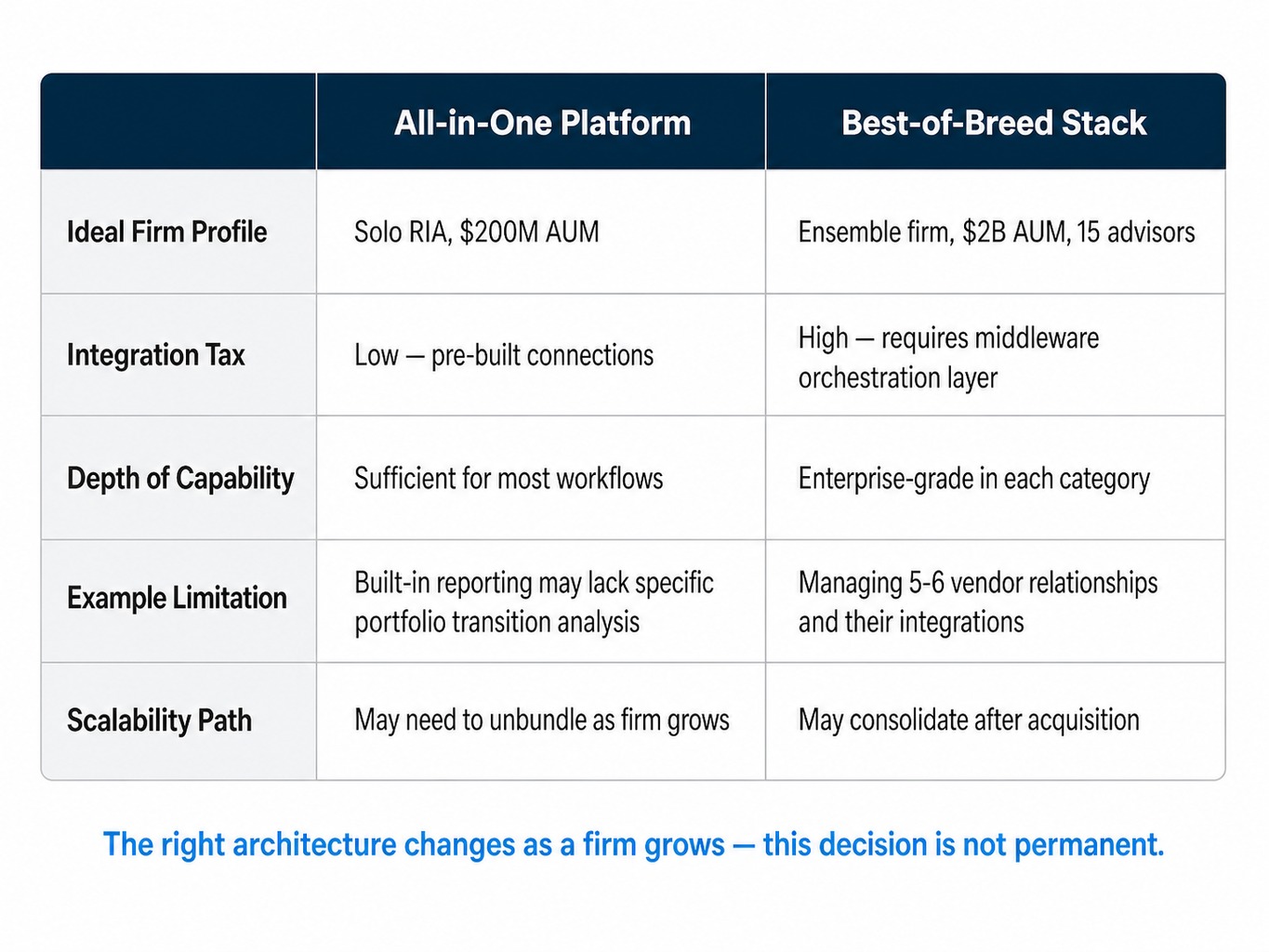
The right RIA technology platform architecture depends on firm size and complexity.
The Integration Tax: The Hidden Cost of Connecting Your Stack
Most firms calculate the cost of their RIA technology platforms by summing up annual subscription fees. Subscription fees may not capture another meaningful cost: what might be called the integration tax. This is the hidden operational cost in time, errors, and manual workarounds created by tools that do not exchange data cleanly and efficiently.
Consider an illustrative scenario common at mid-size RIAs. A firm calculates its annual software spend across its vendor list but may not account for the time operations teams spend maintaining integrations, fixing reconciliation breaks, and formatting outputs from one system into the input format another requires. When firms do account for this labor, the true cost of the stack can be significantly higher than subscription fees alone. This integration tax often goes unrecognized because it shows up on payroll, not on software invoices.
This tax appears in many forms:
- Reconciliation Breaks: The daily or weekly process of manually matching positions between a portfolio management system and a custodial data feed.
- Manual Data Entry: Re-keying client or portfolio information into a financial planning tool that was already captured during statement extraction.
- Disconnected Analytics: A CRM that tracks client interactions but cannot display portfolio-level analytics without a user exporting data from another system and importing it.
- Format Mismatches: Held-away asset data from a 401(k) aggregator that arrives in a different format than custodied holdings, requiring manual cleanup.
Integrations can vary significantly in architecture, from APIs to scheduled file-based exchanges, with different implications for data freshness, maintenance, and workflow design. Evaluating technology on its ability to support straight-through processing and reduce this integration tax is a useful lens. The lowest subscription cost is not always the lowest total operational cost.
Read more: Operational Visibility for Wealth Management Growth | VRGL
Where Portfolio Analysis and Proposal Preparation Fit in the Stack
One potential gap in an RIA software stack sits between having tools for managing portfolios once a client is onboarded (rebalancing, trading, billing) and tools for long-term planning (retirement scenarios). That gap can appear in the workflow that happens before onboarding and between review meetings: turning a prospect's or client's existing portfolio into a clear, analytical, branded comparison against the firm's recommended strategy.
This analysis-to-presentation workflow can be a meaningful source of advisor preparation time. It requires a specific sequence of capabilities:
- Extracting data from client and prospect investment statements.
- Normalizing holdings from multiple custodians into a single analytical view.
- Analyzing the consolidated portfolio across performance, risk, fees, and tax-lot exposure.
- Optimizing a transition plan that accounts for tax consequences and turnover.
- Assembling these analytics into a branded, compliant, and client-ready proposal or report.
When a stack lacks a connected layer for this workflow, firms may rely on a combination of manual processes. Advisors or their teams download data, use spreadsheets to normalize it, run numbers in a separate analytics tool, and then rebuild the outputs in presentation software to make them client-ready. This process can be time-consuming, error-prone, and inconsistent across advisors. Rebalancing tools and proposal-generation tools serve fundamentally different moments in the client lifecycle, and evaluating them as interchangeable can leave parts of the acquisition workflow unsupported by a systematic process.
Read more: How to Create Winning Proposals: 3 Tips for Advisors | VRGL
How VRGL Approaches This Layer of the Stack
The patterns described above manual data entry at intake, disconnected analytics, ungoverned proposal output point to a common architectural gap. Firms often have strong tools for managing portfolios post-onboarding and strong tools for long-term planning, but the workflow between raw prospect data and a client-ready deliverable is left to manual effort.
Repeatable acquisition workflows help close this gap by connecting data intake, analysis, proposal construction, and governance into a single sequence rather than a series of handoffs between disconnected tools.
VRGL is designed as a Growth Platform for wealth management firms. It is the configurable system of work behind advice that supports acquisition, engagement, and firmwide consistency. Within that platform, VRGL Core provides the foundational workflow from data intake through client-ready deliverables, extendable with advanced capabilities based on the firm's needs.
The specific capabilities that address the tech stack gap include:
- Statement Extraction converts multi-custodian PDF statements into structured, analyzable data in minutes, reducing manual data entry at the intake stage.
- Objective Analytics across performance, risk, fees, and diversification are available within the same environment where the proposal is built, so advisors can move from insight to deliverable without switching tools.
- Tax Transition tools help advisors consider the tax-aware path from a current portfolio to a proposed allocation.
- White-Labeled Proposals and Reports assemble analytics into branded, client-ready deliverables that support firm presentation standards.
- Enterprise Governance supports controlled templates, permissioning, version history, and audit trails to help firms maintain consistency across advisors.
VRGL does not replace an advisor's judgment or their core CRM and portfolio management systems. It supports the workflow layer between them, supporting more repeatable and consistent workflows as firms scale.
See how VRGL supports the acquisition workflow behind client-ready deliverables.
Building a Stack That Supports Scalable Growth
An RIA tech stack is not just a checklist of software categories. It can also be evaluated as a production system, where effectiveness is shaped in part by the workflow layers that connect the tools, not just the tools themselves.
The layers that command the most attention, CRM, financial planning, and portfolio management, are well-served by a mature market. But the layers that influence how much time advisors spend preparing for meetings can still show gaps in some stacks. Data normalization, analysis-to-presentation workflows, and firm-wide governance may be left to manual effort, creating an integration tax that can reduce advisor capacity over time.
As firms grow, add advisors, or pursue acquisitions, the cost of this manual friction can increase. Advisory firms that build their technology architecture around workflow outcomes rather than vendor names may be better positioned to identify operational gaps as the industry evolves. By focusing on how data moves from intake to a client-ready deliverable, firms may uncover opportunities to spend less time on preparation and more time on client-facing work.
This article is for informational purposes only and does not constitute investment, legal, or compliance advice. Advisory firms should consult with qualified professionals when evaluating technology architecture decisions.
Frequently Asked Questions
How does custodial choice constrain the rest of an RIA's technology stack?
The choice of custodian is a foundational architectural decision. Major custodians offer different API capabilities, data feed formats, and integration partnerships. This directly impacts which portfolio management systems, trading platforms, and data aggregation tools are practical to implement. A deep integration with one custodian may not exist with another, meaning a future change in custody could force a cascade of changes across your entire tech stack.
How much can an RIA expect to spend annually on its technology stack?
Technology costs vary widely based on firm size (AUM), number of advisors, and architecture (all-in-one vs. best-of-breed). However, subscription fees are only part of the story. The "integration tax," the hidden cost of manual workarounds and operational staff time spent bridging gaps between tools, can represent a meaningful source of cost beyond subscription fees. A useful approach is to evaluate technology cost as a percentage of revenue and, more importantly, in terms of the advisor capacity it consumes or frees up.
How can an RIA migrate from one technology platform to another without disrupting client service?
Firms may consider approaches that reduce disruption during a platform transition. For some, that can mean avoiding a full "big bang" migration and instead moving one functional layer at a time. Data migration, especially historical performance data and client records from a CRM, may warrant particular attention because it can introduce reconciliation and workflow risks. Some firms also choose to run old and new systems in parallel for a transition period to compare outputs and identify discrepancies before completing the cutover.
What can an RIA evaluate before adding AI tools to its tech stack?
Data quality and accessibility are important considerations when evaluating AI capabilities. AI-related tools may be more useful when they can access structured, normalized data across client records and portfolio information. If a firm's data is fragmented across disconnected systems with inconsistent formats, that may affect the reliability or usefulness of the outputs. A strong data aggregation and normalization layer is one foundational consideration within broader AI readiness planning.
How can RIA firms think about cybersecurity when selecting technology vendors?
Cybersecurity is increasingly viewed as a core governance function rather than just an IT issue. When evaluating any technology platform for advisors, firms may assess the vendor's data encryption practices, both in transit and at rest, access controls, audit trails, incident response practices, and third-party security certifications such as SOC 2.